
Why the Most Interesting Homes Aren’t Decorated Overnight

When Did We Start Expecting Our Homes to Be Finished?
There has never been an easier time to decorate a house.
We can sit on an empty living room floor and, before the evening is over, order the sofa, rug, coffee table, lamps, pillows and artwork. A few clicks later, we've selected an entire aesthetic. In a matter of days, boxes begin arriving and the room that was empty last week can look remarkably close to the inspiration photo we started with.
There is something genuinely wonderful about that convenience. Most of us aren't interested in spending six months searching for a bedside table simply for the principle of it.
But somewhere along the way, convenience seems to have created another expectation: that our homes should come together quickly.
We see finished rooms constantly. Beautifully photographed homes appear on our screens without the years that preceded them. We see the final arrangement, not the awkward period when the owners lived with an empty wall because they hadn't found the right thing yet. We don't see the sofa that came before this one, the table that belonged to someone's parents, or the years when the budget simply didn't allow for replacing anything.
We see the finished room and assume finishing the room is the goal.
So an empty corner begins to feel like a problem. The wall needs something. The shelf needs styling. The guest room should really be done before people come for Thanksgiving. And once we begin thinking that way, it's remarkably easy to buy things simply because a space needs filling.
But think about the homes you've found most interesting.
They're rarely interesting because everything was purchased at once. Usually, there's something you want to walk over and look at more closely. An old wooden cabinet beside a newer sofa. A small painting tucked somewhere unexpected. Books that were obviously bought to be read rather than styled. A dining table surrounded by chairs that don't quite match.

Someone tells you where something came from, and suddenly you notice something else.
These homes have layers.
Some things were carefully chosen. Others were inherited. A few were probably bought on a whim. There are pieces that have moved from house to house and others that only recently arrived. Something inexpensive sits comfortably beside something worth saving for.
The result is a home that couldn't have been purchased in an afternoon.
And perhaps that's precisely why it feels so good.
A Collected Home Leaves Room for Discovery
There is a difference between furnishing a room and allowing one to develop.
Furnishing is necessary. We need somewhere to sit, a table to eat at, a lamp to read by and a bed to sleep in. But once those needs are met, something slower can begin.
You travel somewhere and find a piece of pottery made by a local artist, and years later you can still remember the little shop where you bought it. A friend gives you a painting because she saw it and immediately thought of you. Your parents downsize, and suddenly the small cabinet that stood in their hallway for as long as you can remember is standing in yours.

Maybe you spend three years looking for a chair for one particular corner, then find it when you aren't looking at all. Or someone brings home a strange little object from a flea market that nobody else in the family understands. Twenty years later, everyone would notice if it disappeared.
None of those things were purchased as part of a decorating plan, and that's part of what makes them interesting.
A collected home isn't necessarily full of antiques, nor does it need to be eclectic or maximalist. A very simple room can be collected over time. So can a contemporary home. The distinction is less about how much is there and more about why it is there.
When objects arrive for different reasons and at different points in our lives, they naturally bring variation with them. Different woods. Different periods. Different textures. Something handmade beside something modern. A family piece beside something purchased last year.
Instead of everything speaking with exactly the same voice, the room begins to have a conversation.
Not Everything Needs to Match
For a long time, matching was one of the easiest ways to know we'd gotten a room "right."
Bedroom sets matched. Living room furniture came as a suite. Wood tones were coordinated. Fabrics repeated. If we found the right end table, buying the matching coffee table seemed like the obvious choice.
There is comfort in that kind of order, but too much agreement can remove the very thing that gives a room character.
Think of an old dining table surrounded by newer upholstered chairs, or a clean-lined sofa beside a table that has been in the family for years. Contemporary art can hang beautifully over an antique chest. A traditional wool blanket can be perfectly at home folded over the arm of a modern chair.

None of those combinations needs to be dramatic. In fact, the best ones often aren't. They simply allow different periods to exist together, much the way our lives do.
We don't discard every possession from one chapter of our lives when another begins.
The bowl we bought for our first apartment can end up in the kitchen of the house where we're raising children. A piece inherited in our twenties might finally make sense to us in our forties. Something that once seemed too traditional becomes exactly what a newer room needed.
Our tastes change, but they don't always have to erase what came before. That's how a home begins to develop depth.
The Empty Space Isn't an Emergency
Perhaps one of the hardest parts of creating a home slowly is learning to tolerate what isn't finished.
It might be the empty wall, the corner with nothing in it, the rug that's a little too small because replacing it isn't important enough yet, or the dining table you've had since your first apartment even though you've been saying for five years that you'll eventually replace it.
There is an impulse to resolve these things because we're surrounded by solutions, and most of them can arrive at our doors within days. If the space above the sofa is empty, there are thousands of pieces of artwork available tonight. If the bedroom feels unfinished, we can buy a complete set of accessories designed to make it feel cohesive.
Sometimes that's exactly what we should do.
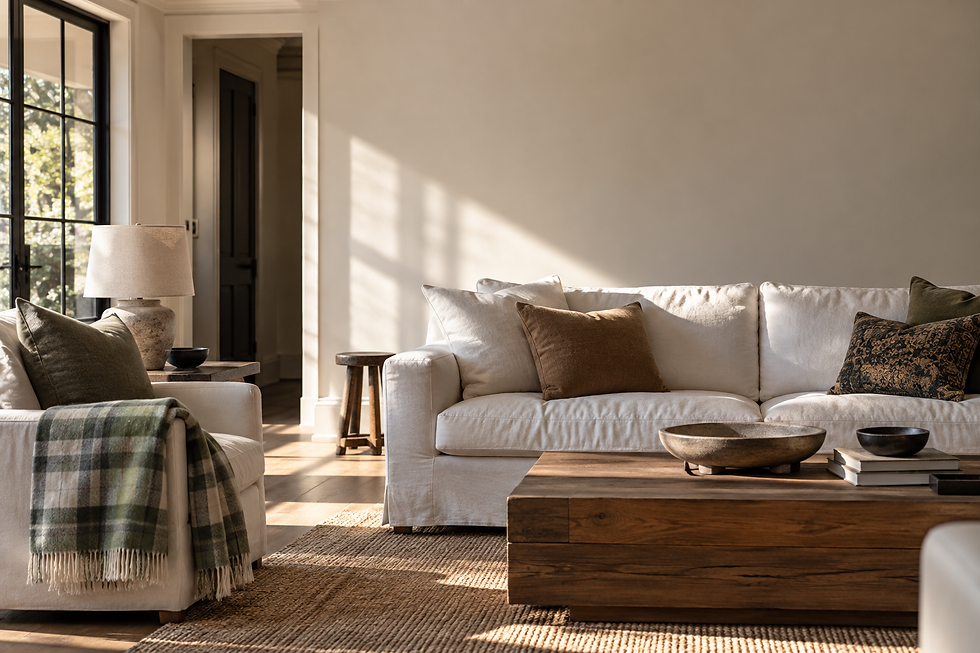
But sometimes an unfinished space is simply a space waiting for its story.
Maybe the artwork hasn't been found yet because you're going to discover it on a trip next summer. Maybe the old dining table stays long enough that you stop wanting to replace it. Maybe the empty corner doesn't need anything at all.
Living with a room gives us information that decorating it immediately cannot. We learn where the afternoon light falls and where everyone naturally puts down a cup. We discover which chair nobody sits in and which one everyone fights over. We realize the room needs another lamp more than another decorative object, or that the beautiful coffee table we imagined would actually interrupt the way people move through the space.
A house teaches us how we live in it. But we have to give it enough time to tell us.
Sometimes the Best Things Aren't Found While Shopping for Them
Ask someone about the most interesting thing in their home and there's a good chance the story doesn't begin, “I needed something for that wall.”
It begins somewhere else.
We found it when we were...
It belonged to my...
My grandfather made it...
I almost didn't buy it...
They were going to throw it away...
The object becomes interesting partly because the story of finding it has become attached to it.
That doesn't mean every purchase needs a remarkable origin story. Sometimes you need a lamp and you buy a lamp. But there is something different about leaving enough openness in a home for unexpected things to find their way into it.

Estate sales, local makers, antique shops and art fairs become possibilities. So does the woodworking studio discovered while traveling, the piece offered when a family home is emptied, or the textile made somewhere with a long tradition of weaving them.
These things don't arrive on the same day, which means the room doesn't either.
It grows in layers. And perhaps that is what we're actually responding to when we walk into a home that feels especially personal.
We aren't simply seeing good design.
We're seeing time made visible.
The Things Worth Waiting For
There is another reason to allow a home to take time: some things are worth waiting for.
Craftsmanship often asks that of us.
A piece made thoughtfully from good materials may cost more than the quickest alternative. Sometimes that means waiting until the budget allows. Sometimes it means buying fewer things. Sometimes it means choosing one beautiful piece and allowing the rest of the room to remain imperfect for a while.
That isn't deprivation.
It's discernment.
The same principle applies whether we're choosing a dining table, a piece of art or a wool blanket.
We don't need every object in our homes to last for generations. That would be an impossible standard, and probably an exhausting way to shop.
But there are certain things we can choose with longevity in mind.
Natural materials that become more familiar with use. Construction that can withstand everyday life. Designs that aren't dependent on a single moment in fashion. Objects made by people and companies whose work we value.
The goal isn't to predict what we'll love thirty years from now.
It's simply to give ourselves a better chance of still wanting it around.
A Home Can Hold More Than One Version of You
Perhaps this is the part of a collected home that matters most. Our homes don't only change because decorating trends change.
We change.
The person who moved into the first apartment isn't exactly the person who bought the first house. The couple furnishing rooms before children may someday be rearranging those same rooms after the children leave. Careers change. Families grow. People we love come and go. We travel. We learn. We inherit things. We become attached to things we never expected to care about.

If we allow it, a home can hold evidence of all those versions of us.
The painting from the first apartment doesn't have to disappear because the furniture became more sophisticated or the battered table can stay after the kitchen is renovated.
And then there is the blanket bought when the children were young can eventually move from the family room to a guest bedroom and, years later, somewhere else entirely.
Objects migrate through a house just as we move through different seasons of our lives.
Some will eventually leave. Others will surprise us by staying.
And the ones that stay become threads connecting one version of home to another.
That's difficult to achieve when every room is periodically wiped clean and rebuilt around the newest idea of what it should look like.
A collected home allows the past to remain present without becoming trapped in it.
The Most Interesting Homes Are Never Really Finished
Maybe that's the secret.
The homes that draw us in aren't necessarily finished at all.
They're still becoming.
There's a wall waiting for the right piece of art. A chair that may eventually be reupholstered. A shelf with room for something that hasn't been found yet. There are objects that have been there for decades and others that haven't arrived.
Life will rearrange things anyway.
Children grow. Furniture moves. Something breaks. Someone inherits a chest. A new piece replaces an old one, and the old one moves upstairs because nobody is quite ready to let it go.
The room changes.
And that's not a failure to finish decorating.
That's the home doing what a home is supposed to do.
It is accommodating a life.
At Stillwell, this is part of what draws us to objects made with care and to American mills and makers whose work is intended to remain useful long after the moment of purchase has passed. A good wool blanket doesn't need to transform a room.
It can simply enter it.
It might begin neatly folded across the foot of a bed. Later it moves downstairs. Someone pulls it over their shoulders on a cold morning. It travels to the porch, the guest room, a football game or a Christmas parade. Years pass. The room around it changes.

Eventually, no one remembers exactly when it stopped being the new blanket.
It simply belongs there.
And perhaps that's the best thing we can hope for from the objects we bring into our homes.
Not that they complete the room.
But that they're good enough, useful enough and meaningful enough to become part of whatever happens next.

Comments